
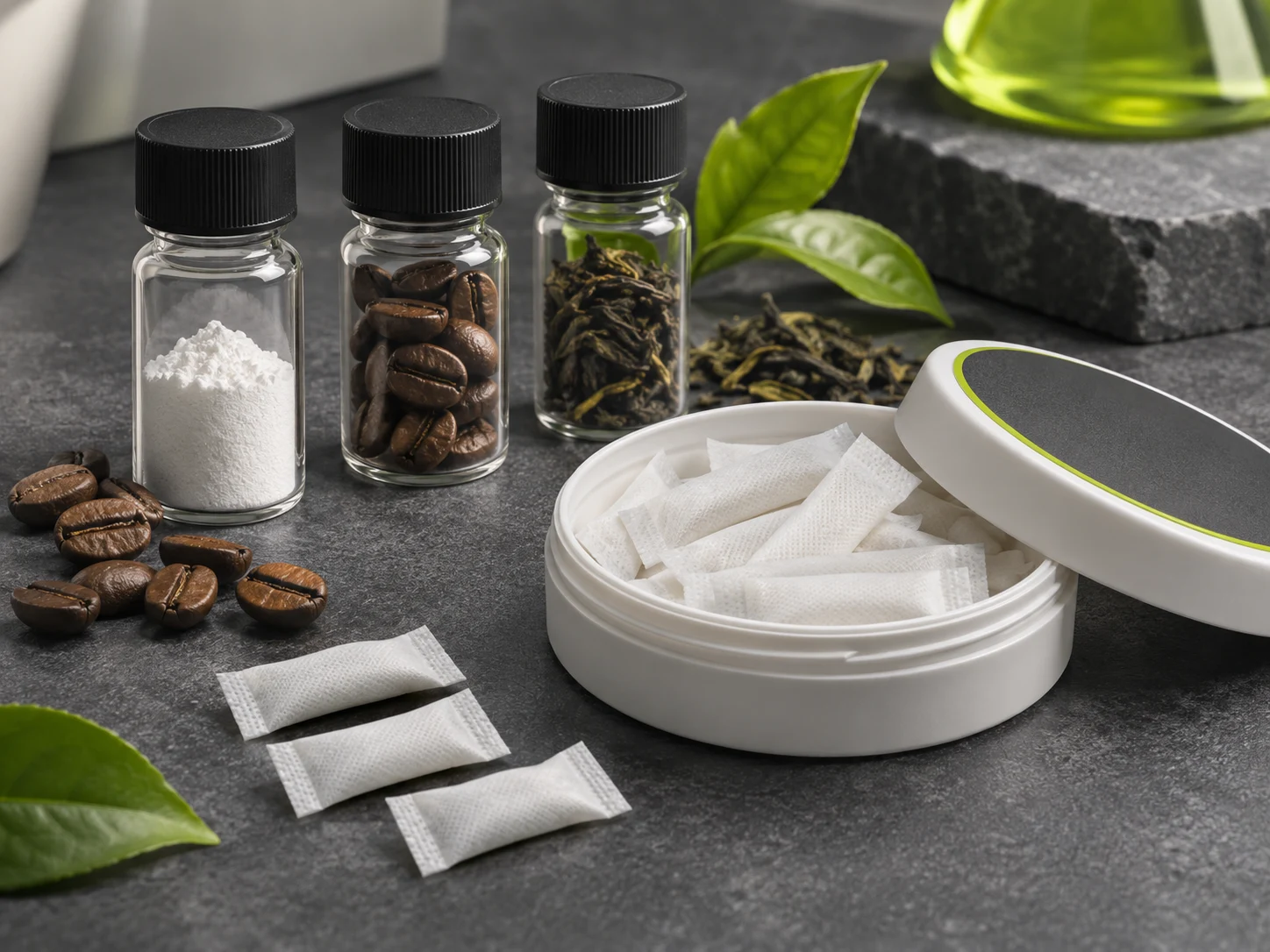
Caffeine pouch ingredients start with identity
Natural caffeine pouches need a traceable source claim. Caffeine anhydrous, purified caffeine derived from coffee or tea, and caffeine-containing botanical extracts have different specification questions. “Natural” does not establish safety, a release profile or a regulatory classification.
Compare what the certificate actually measures
| Material | Useful specification fields |
|---|---|
| Purified caffeine | Identity, assay basis, impurities, water and source documents |
| Guarana extract | Species, part, extraction, caffeine assay and marker basis |
| Coffee or tea extract | Extraction details, caffeine contribution and relevant impurities |
| Carrier/sweetener | Identity, grade, particle/flow behavior and label basis |
Separate extract weight from caffeine weight
An extract entry on a formula is a material mass. Its caffeine contribution requires the assay fraction on the same basis. Correct for dry-basis or as-is differences when applicable and keep all units explicit. Finished-product analysis checks the result in the actual matrix.
Check the whole product for source claims
Plant based caffeine pouches involve more than the caffeine source. Carrier, flavors, processing aids, contact bag and pack claims each need support. A supplier statement for one ingredient cannot establish a claim about the complete product.
References and scope
Official general information is background. It does not certify this pouch format or establish the result of a specific finished product.
Project questions
What should I send for this review?
Send the target market, formula and pack version, the question you need answered and existing documents. Identify which values are proposed and which have already been approved.
Does this guide define an approved product specification?
No. Use the guide to prepare a project-specific review. Methods, acceptance criteria and responsibilities are agreed for the actual formulation, pack and market.