
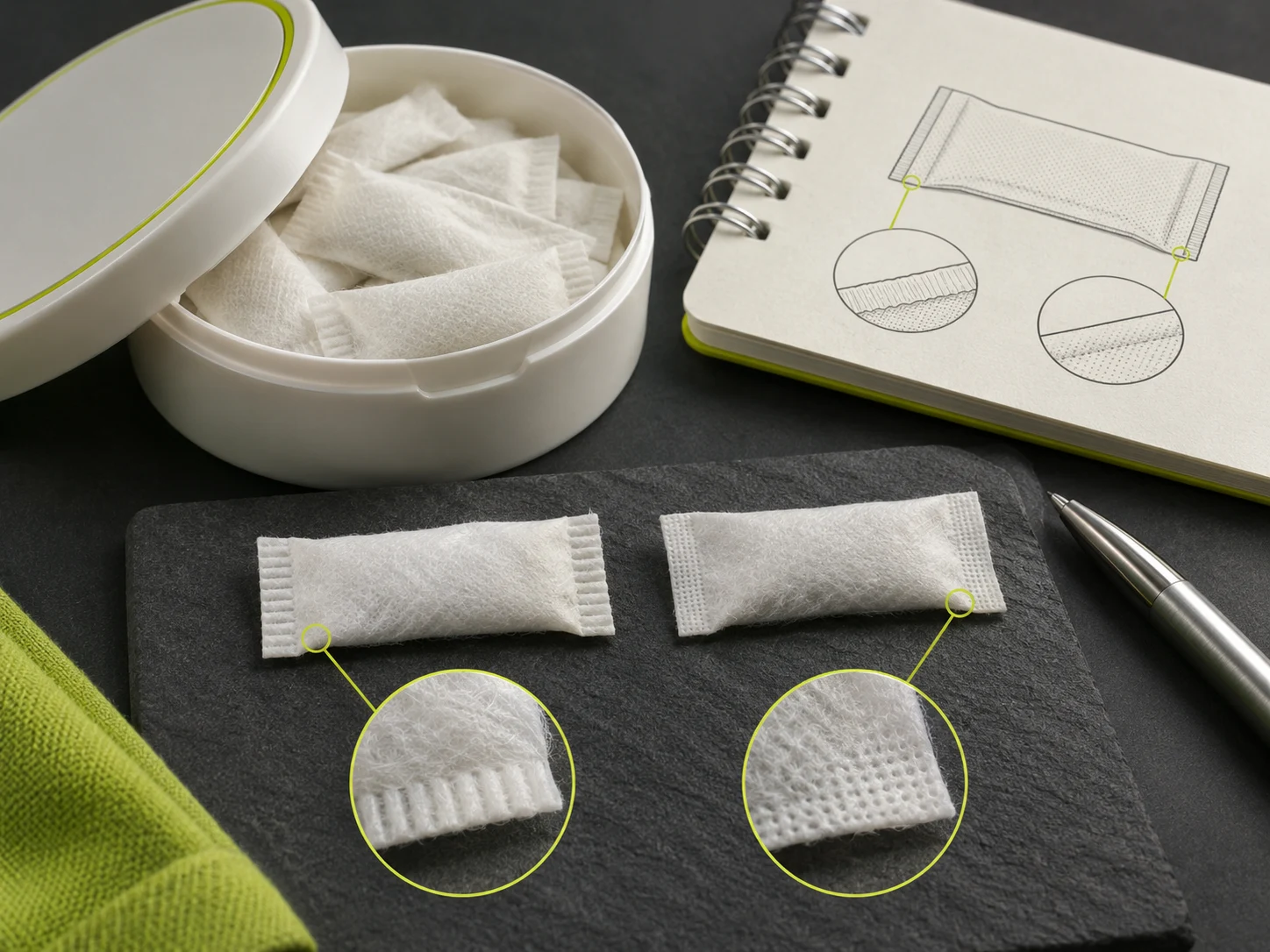
A pouch can look acceptable in a product photograph and still leave important engineering questions open. The contact material, seam geometry and forming process belong in the specification because they help determine how the filled unit handles, feels and retains its contents.
Specify the bag as carefully as the blend
A useful material record identifies composition, grade, supplier and dimensions. Add the properties relevant to the process, such as basis weight or material orientation, when they affect the decision. Obtain documentation suited to the actual contact and intended use; visual resemblance to another pouch is not evidence of suitability.
State which dimensions refer to the complete bag and which refer to the filled area. Include the seam location and relevant tolerance. A nominal “slim” or “mini” name does not define length, width, fill weight or the available space for a particular blend.
Compare constructions under a defined question
Pressed-edge and ultrasonic seam constructions can both be explored. Their suitability depends on the actual material and process. A development comparison should state whether the question is handling strength, powder retention, feel, appearance or release behavior.
When possible, keep the formula and fill condition consistent while comparing the material or seam. If the fill, bag size and seam all change, the result may still be useful for selecting a whole format, but it will not isolate the influence of one variable.
Record the failure mode
A simple “pass” conceals information that may be needed during transfer. Record the test or handling condition, conditioning, sample identity, sample count and observed failure. A seam opening, a fabric tear and powder escaping through the material are different observations.
- Identify whether failure occurs at the seam or fabric.
- Record visible fill contamination at the sealing area.
- Include relevant handling and storage conditions.
- Keep photographs tied to the sample and method version.
Connect the pouch to the pack
A sound contact bag is only one layer of the system. The retail can, closure, liner and optional barrier influence moisture exposure and handling. Review the assembled pack rather than approving each component in isolation.
Closure descriptions also need care. A catalogue may call a format child-resistant, but the label alone does not establish tested performance. Confirm the applicable requirement, test scope and actual closure design for the market before using such a statement publicly.
Keep use and evidence specific
A nonwoven bag is not a dissolving oral film. Do not infer that it should dissolve or be swallowed from its small size. Product-specific instructions and disposal information must fit the material and intended market.
Release testing can help compare a material change under a defined method. It cannot independently establish human absorption or onset. A bag approval, a release comparison and a consumer claim each answer different questions and should retain their own evidence.
A procurement question
Can a bag size be selected before the formula is finished?
A reference format can guide early work, but final dimensions, fill mass, material and seam need confirmation with the actual blend and process. Treat the early selection as a proposal.
References
Prepared by the CaffeinePouch OEM editorial team. Technical sourcing guidance, updated 3 November 2026. Illustrative examples are not a product specification, a dose recommendation or a finished-product test result.
Send your project brief or review the specification worksheet.