
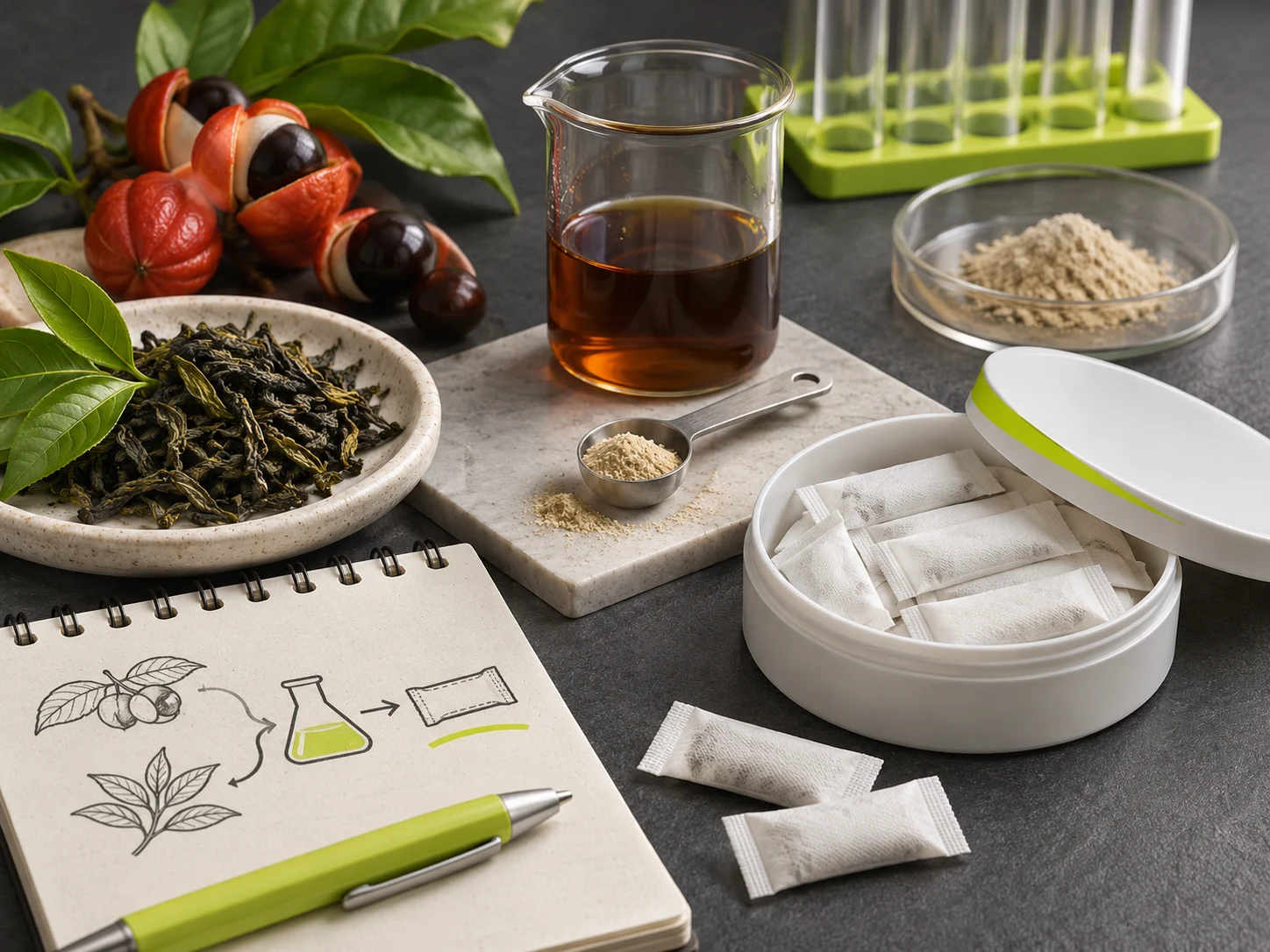
A formula line reading “guarana extract 100 mg” leaves a critical question unanswered: how much caffeine does that particular material contribute? The answer starts with the lot specification and assay basis. It ends with a defined finished-pouch check, not with the extract’s marketing name.
Start with a material register
List every ingredient that can contribute caffeine. This may include purified caffeine, guarana, coffee extract, tea extract or another botanical material. Record the supplier, material code, lot, mass per pouch, caffeine assay and whether that assay is reported on an as-is or dry basis. Keep the underlying certificate with the formula version.
A generic extract description is insufficient when the proposed formulation depends on a particular caffeine level. A change in source or standardization can alter the theoretical total even if the same extract mass is weighed. The approved material specification and the substitution rule should therefore be part of the transfer package.
Make the calculation auditable
For one material, theoretical caffeine equals material mass multiplied by its caffeine mass fraction. Add the contributions from every source. Convert percentage values to fractions before multiplication, and keep micrograms and milligrams distinct.
For arithmetic illustration, 100 mg of an extract at 10% caffeine contributes 10 mg. An additional 20 mg of pure caffeine makes the unadjusted theoretical total 30 mg. This example explains a calculation; it does not propose a product dose. Purity, moisture basis and other relevant factors must be handled consistently for the actual ingredients.
- Write the unit beside every value.
- State the assay basis and any conversion.
- Keep each source contribution visible.
- Give the worksheet a formula revision and review date.
Do not replace analysis with arithmetic
The calculation describes the intended composition using the inputs available. An analytical method checks caffeine in the sampled finished matrix. Extraction recovery, selectivity, calibration and sampling all matter. A result should identify the method, the unit basis and the actual samples tested.
An average also has limits. Pooling several pouches can provide a composite result while concealing differences between units. If consistency is the decision, agree an appropriate unit-level or production sampling plan. Do not label an average as a uniformity study without the supporting design.
Use caffeine guidance within its scope
FDA’s consumer information cites 400 mg per day as an amount not generally associated with negative effects for most adults, while emphasizing variation in sensitivity and other circumstances. That general intake context does not establish an appropriate amount per oral pouch or the safety of a finished formulation.
EFSA’s caffeine assessment concerns defined exposure scenarios and populations. A sourcing team should preserve those conditions when referencing it. Neither source turns an ingredient calculation into a finished-pouch approval, and neither supports converting a general daily figure into a website recommendation for a number of pouches.
Investigate before reformulating
If the result differs from the calculation, first check the material assay and its basis, weighing records, blend behavior, fill weight and sample identity. Then review the analytical method and sampling. Changing the formula immediately may conceal the original cause and make the next result harder to interpret.
Close the investigation with the original observations, the cause supported by evidence, the action and any verification required. If a raw material is replaced, assess whether the label, sensory result, method or stability plan also needs revision.
A procurement question
What should accompany a guarana sample request?
Provide the botanical identity and extract specification, available lot assay, proposed extract mass, other caffeine sources and the target market. State which values are proposals and what finished-product verification is needed.
References
Prepared by the CaffeinePouch OEM editorial team. Technical sourcing guidance, updated 3 November 2026. Illustrative examples are not a product specification, a dose recommendation or a finished-product test result.
Send your project brief or review the specification worksheet.