
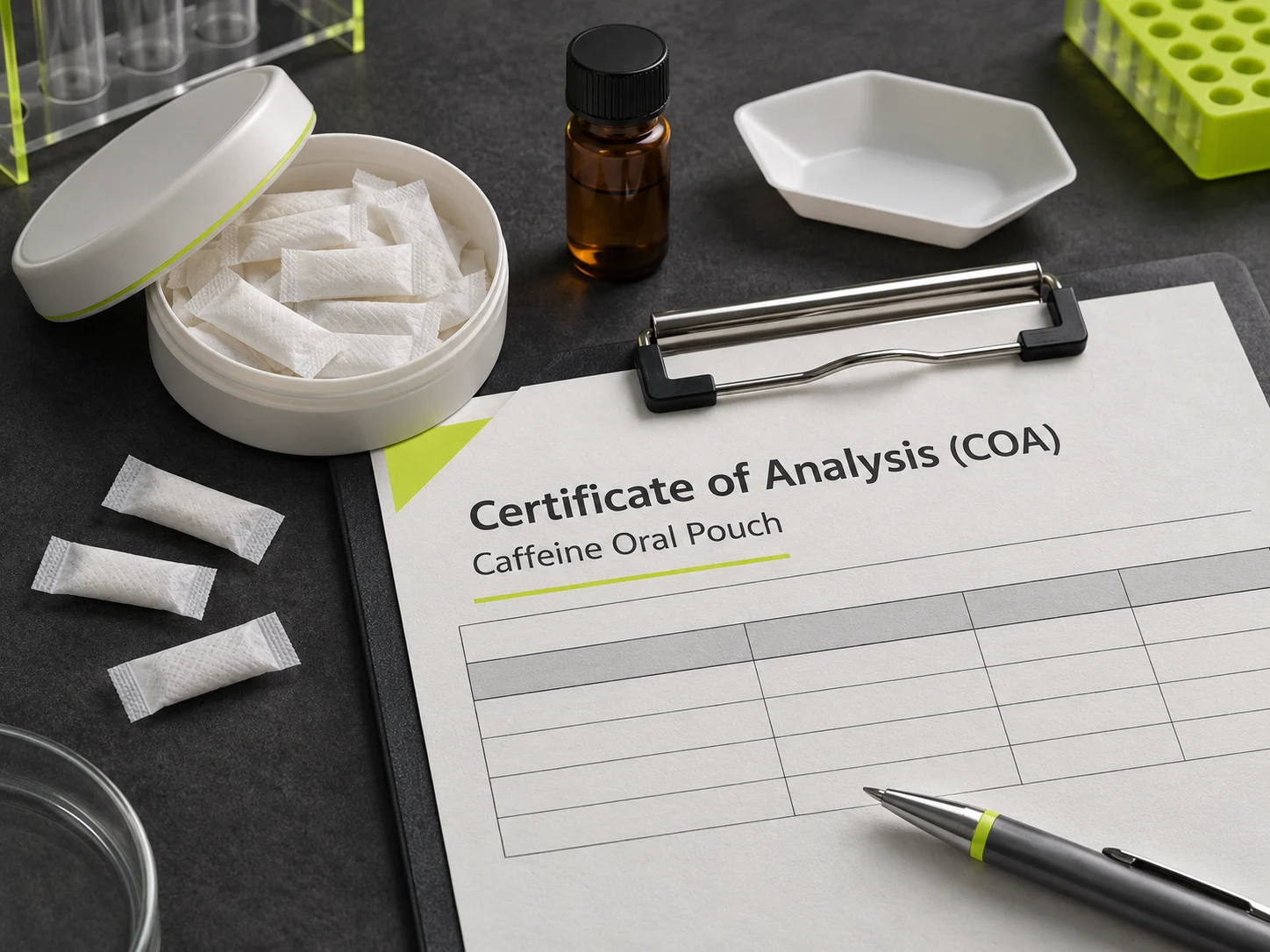
A certificate of analysis is useful when it can be connected to the actual batch and specification. The title “COA” alone says little about the scope. Start by asking what material was tested, what the reported result represents and which decision the document supports.
Check identity before the results
Look for the product or material code, batch number, formula or specification revision, sample date and report identity. Confirm that the document refers to the finished pouch when that is the evidence you need. A raw-material caffeine certificate cannot establish the content of a completed unit.
A report may cover one ingredient, a blend, a composite of several pouches or individual units. Those are different samples. Keep their identity visible when sharing documents with procurement, quality and market-review teams.
Read the units and basis
A caffeine result may be expressed per pouch, per gram of fill or as a percentage. Converting between them requires the relevant mass basis. A serving result is incomplete if the serving definition is missing. The same care applies to a vitamin reported in micrograms and a mineral reported as salt mass rather than elemental content.
Check whether the result is measured, calculated or reported from a supplier document. All can be useful within a clear scope, but they should not be presented as the same kind of evidence.
Ask what the method can establish
A method needs to be suitable for the actual matrix and the question. For caffeine analysis, extraction, selectivity, calibration, recovery and precision can matter. A method name without conditions or suitability information may not explain how flavors, botanicals or contact material were handled.
- Identify the method and version.
- Check the sample preparation and unit basis.
- Ask about recovery and interference where relevant.
- Clarify uncertainty or reporting limits when they affect the decision.
Distinguish average content and uniformity
A composite result can estimate an average for the combined sample. It does not show the distribution between individual pouches. When unit consistency matters, request the actual sampling design and the unit-level results or other justified evidence used for that decision.
Do not apply an arbitrary tolerance copied from another product category. Acceptance criteria need an applicable basis, a defined method and the agreed specification. An investigation should retain original results and explain any resampling or retesting.
Keep the document in its evidence family
A COA does not replace a specification, an SDS, a stability study or a market review. It also does not make an effect claim true. For example, a caffeine assay cannot establish that a pouch acts faster than coffee, while a laboratory release test cannot independently establish human absorption.
FDA and EFSA publish general caffeine information, but those sources do not approve this finished pouch or certify an individual batch. Keep ingredient facts, batch results and broader safety context separate in the product evidence file.
Before approving supply, link the COA to the batch record, the approved specification and the responsible release decision. That connection makes the document useful when a supplier changes, a complaint arrives or a later result needs investigation.
A procurement question
Is a “pass” result enough to compare suppliers?
Ask for the actual specification, method, sample identity and reported values where available. A pass statement without its scope may conceal differences in units, sampling or criteria.
References
Prepared by the CaffeinePouch OEM editorial team. Technical sourcing guidance, updated 3 November 2026. Illustrative examples are not a product specification, a dose recommendation or a finished-product test result.
Send your project brief or review the specification worksheet.