
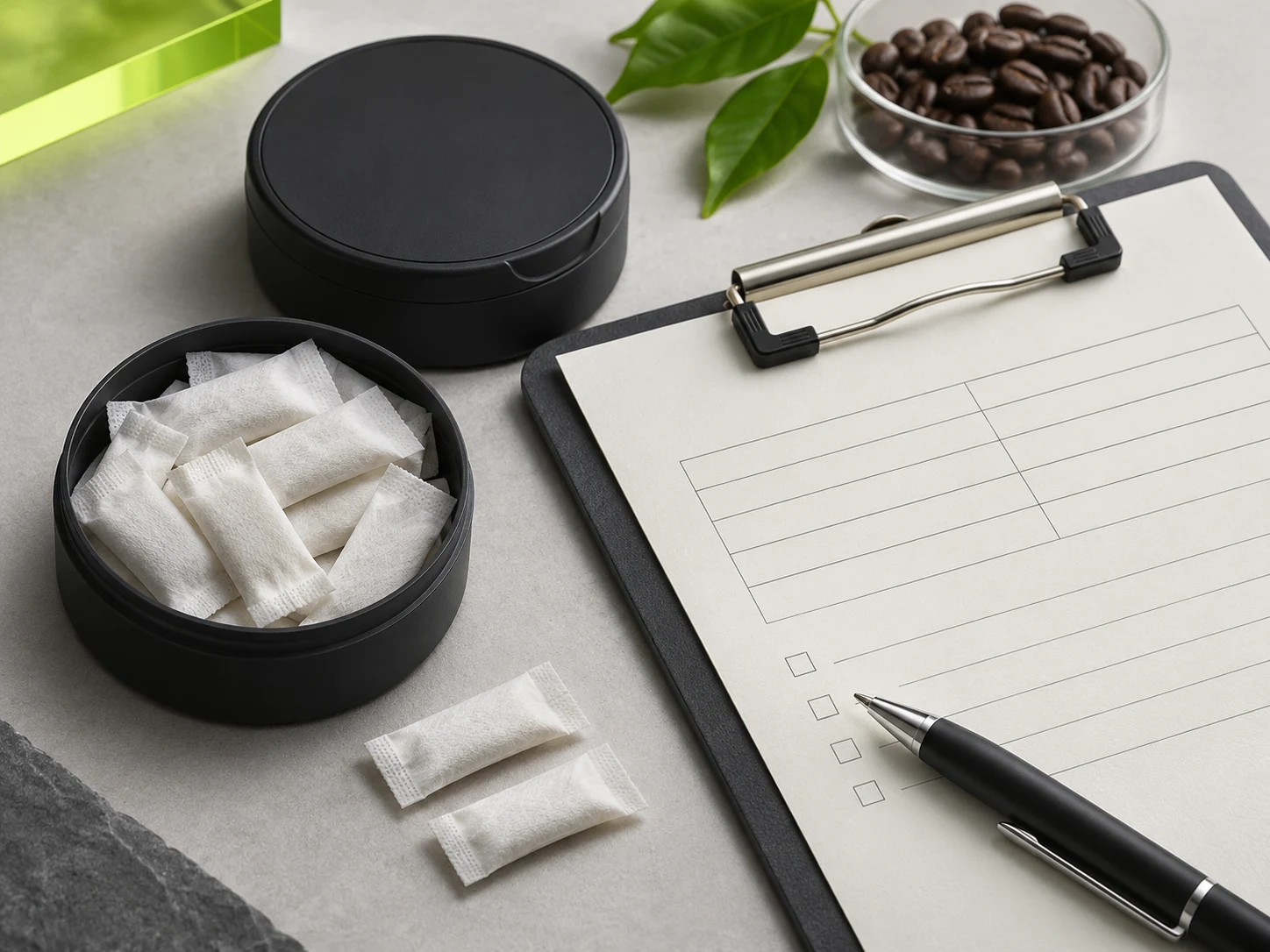
A first request for quotation does not need a finished formula. It does need enough structure for suppliers to identify the work they are being asked to price. A short, explicit brief usually produces a more useful discussion than a long list of desired effects.
Name the product and market
State that the project is a caffeine oral pouch, identify the destination market and describe the intended sales channel. Clarify whether the work starts from a controlled formula, an early concept or an existing product needing transfer. These inputs affect the service scope and the evidence that needs review.
Describe the actual decision you want from the first response: an initial feasibility opinion, a sample plan, a development offer or a manufacturing quotation. This helps avoid comparing a narrow production price with an offer that includes substantial development.
Separate proposals from confirmed values
You may have a preferred caffeine source, a flavor direction or a can style without having an approved specification. Mark those as preferences. If the caffeine content or quantity is still open, say “need technical guidance” or “under evaluation” rather than entering a number solely to complete a form.
- Name proposed ingredients and forms where known.
- State ingredients or sources that must be excluded.
- Describe flavor, cooling and pouch feel separately.
- Identify the desired pack and the quantity unit.
Ask for deliverables, not only a unit price
An OEM quotation may assume that the formula and methods are already defined. ODM work can include development rounds and packaging decisions. A CRO scope should identify a study question, protocol and report. A CDMO proposal should connect milestones to transfer and manufacturing responsibilities.
Ask which analytical work, artwork, tooling, samples and freight are included. State whether quantity means pouches, cans or cartons, and whether multiple SKUs share a platform. Compare currency, offer validity, payment terms and exclusions on the same basis.
Put evidence in the proposal
Request the actual manufacturing site and the applicable scope of its documents. Ask who performs the required tests, who releases the finished batch and how changes are approved. A certificate should identify the entity, site, scope, issuer and validity; it is not a substitute for the product specification.
Keep ownership and confidentiality explicit. Formula rights, permitted reuse, exclusivity and technical-transfer access are commercial questions that should not be assumed from the acronym printed on a supplier page. For confidential composition details, agree suitable terms before sending a full formula.
Make the first sample round answer a question
For a sensory comparison, specify what should remain constant and what will change. For packaging, identify whether the issue is the opening, seam, barrier or label area. A trial with many simultaneous changes can select a preferred overall concept but may not explain which variable caused the difference.
Request a version number and a feedback method with each sample. Confirm charges, shipping and evaluation instructions before dispatch. The first sample date is one milestone; it does not prove a formula is market-ready or that a complete stability study has finished.
A procurement question
What is the minimum information needed to start?
Send your name, company, work email, target market, formulation direction and the help you need. Add pack, quantity and documentation preferences when known. Unknown values can remain explicitly open.
References
Prepared by the CaffeinePouch OEM editorial team. Technical sourcing guidance, updated 3 November 2026. Illustrative examples are not a product specification, a dose recommendation or a finished-product test result.
Send your project brief or review the specification worksheet.